
How to Search Criminal Dockets
The search itself begins at Kansas CaseSearch. Pick District as the court level. Then choose your key. Your options are case number, party name, business name, party as business name, or citation number. Type the term, select Kearny County, and add the Criminal filter. A date of birth or a filing-date range can narrow a common name. Finish the human check and submit.
A case or citation number is the strongest key when you have one. Name searches can pull spelling variants and strangers with similar names. Compare county, case type, party role, filed date, and event history before trusting a match. The anonymous form offers no booking-number or judicial-officer field. A missing search control is not a lookup method.
- Confirm that the matter belongs to Kearny County District Court.
- Open Kansas CaseSearch and select District.
- Choose the best search type and enter the exact known term.
- Select Kearny County and the Criminal filter.
- Open the matching result and read the newest events before drawing a conclusion.
- Use the clerk or courthouse terminal for permitted information missing online.
Kearny Criminal CaseSearch Fields
The live Kansas CaseSearch application shows the current search structure for Kearny County criminal dockets.
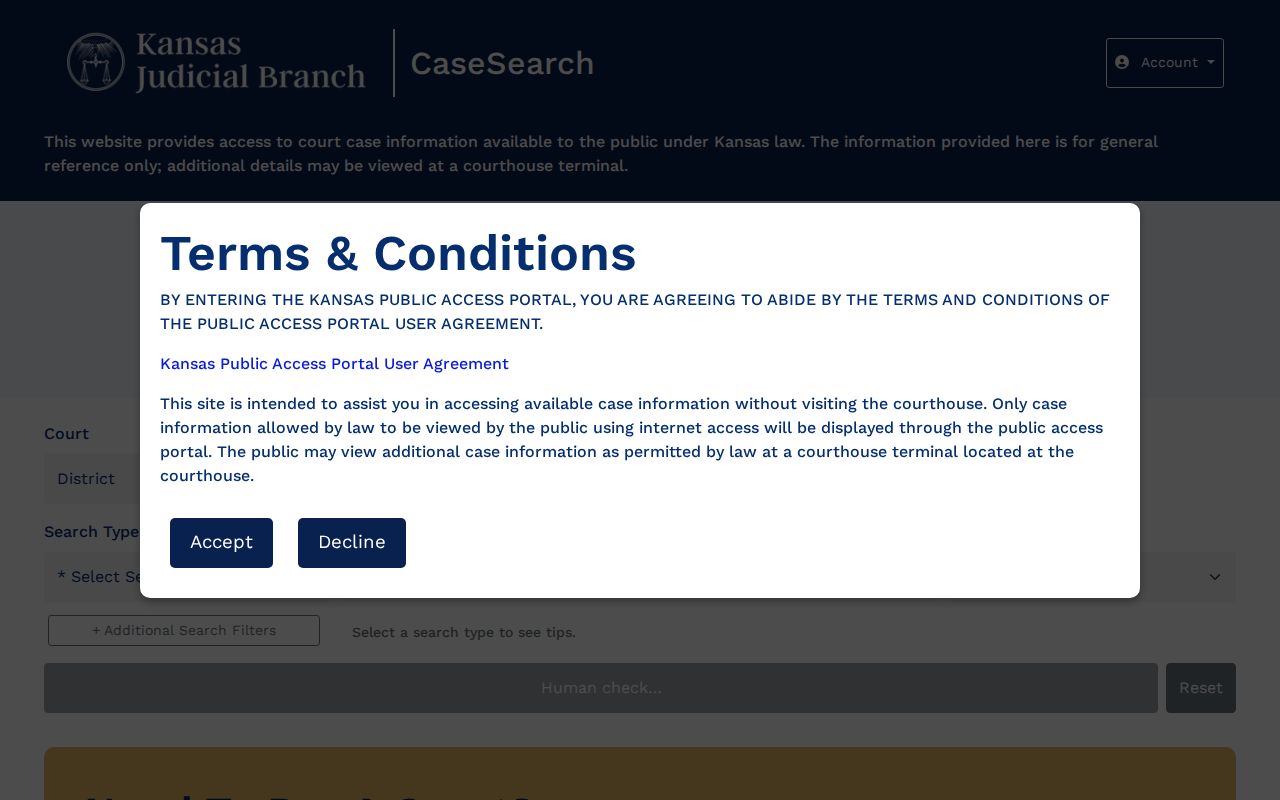
The interface splits public search keys from the details that open once a matching row appears. A feature in the application code is no promise that every field shows up in a given public criminal case.
| Field | Use | Kearny search note |
|---|---|---|
| Court | Select court level | Choose District |
| Search Type | Number, name, business, or citation | Use case number when known |
| Search Term | Enter the selected identifier | Copy official spelling or number |
| County | Narrow statewide results | Select Kearny County |
| Case Category | Limit by subject | Select Criminal |
| DOB or File Dates | Optional narrowing controls | Use only when appropriate |
What a Criminal Docket Shows
Open a Kearny County criminal docket. You may see the court, case category, filed date, status, judge, party roles, attorneys, and a chronological events index. Entries can also carry a charge category, citation or cross-reference, settings, orders, document links, a disposition, financial entries, or a warrant or protection-order indicator. Redaction and access rules shape what appears.
A charge line states an allegation or a filed classification. It is not a finding. Look to the dated docket event, and when needed the linked order, to read a guilty plea, judgment, dismissal, diversion, sentencing event, or other outcome. A bare closed status never explains how the matter ended.
| Case Number | The unique court key. Use the exact official number, not a guessed local format. |
|---|---|
| Case Header | Kearny County, criminal type, filed date, status, and judge when public. |
| Party and Counsel | Public roles and attorney links, subject to access limits. |
| Case Events | Dated filings, appearances, settings, rulings, and changes. |
| Disposition | The event or order showing how the case concluded. |
| Access State | Public document link, redaction, seal notice, or remote-access omission. |
Kearny Criminal Docket Court Layers
Kearny County District Court holds the felonies and state criminal cases. District Magistrate Judge Darrell L. Walters is the named Kearny magistrate. District judges across the 25th Judicial District may also take assignments. The magistrate sits inside the district court itself. There is no separate county docket office for that role.
City-ordinance misdemeanors start in Lakin or Deerfield Municipal Court. They stay municipal cases no matter that the city lies in Kearny County. An appeal, though, creates a new district-court appeal record. Federal criminal matters belong to the U.S. District Court for the District of Kansas. They are searched through federal systems, not Kansas CaseSearch.
| Matter | Court layer | Starting search |
|---|---|---|
| Felony or state misdemeanor | Kearny County District Court | Kansas CaseSearch |
| Lakin city ordinance | Lakin Municipal Court | Municipal court clerk |
| Deerfield city ordinance | Deerfield municipal channel | City clerk |
| Federal criminal case | District of Kansas | PACER or federal clerk |
Stages on a Criminal Docket
The events index lets you follow a state criminal case through its recorded stages. The exact path varies. After an initial appearance or arraignment may come motions, pretrial settings, a plea, trial, disposition, sentencing, or later review. A dismissal or diversion can break the ordinary sequence. Let the docket's own event labels and orders control.
Docket flow: Filing › Arraignment › Pretrial › Plea or Trial › Disposition › Sentencing
A setting is a court date, not a result. A plea event is not the plea document. A disposition reports an outcome category, yet the signed order may hold the real terms. Read each event with its date and any linked public document instead of treating the process line as a guarantee.
- Arraignment
- A charge and plea stage when that label appears.
- Pretrial
- A case-management or motion stage before trial.
- Continuance
- A change that can leave the old date in the event history.
- Disposition
- The event that records dismissal, plea, judgment, diversion, or another outcome.
- Sentencing
- A post-plea or post-verdict setting, separate from the filed charge.
Kearny Criminal Dates Can Change
In a Kearny County criminal docket, the newest operative setting matters more than the first date listed. One reset can spawn several entries. You might see the original setting, a request or order, a continuance event, and a later date. Read the most recent event and any attached order. The 25th Judicial District calendar helps, but it is only a publication layer and may be empty or incomplete.
Compare the docket against the written notice. If they conflict, call the district clerk at 620-271-6254. The jury-status line, 620-271-6120 with option 2, handles jury instructions. It is not the general criminal docket number. The local jury page carries its own timing and entry rules for summoned jurors.
A past event marked reset, continued, pass, or not reached is not a dismissal. Confirm the current date, time, courtroom, judge, and setting type before you appear. The court posts no standing Kearny videoconference link. Follow only the remote instruction issued for the actual case.
Which Court Holds Criminal Dockets
Felony and state misdemeanor dockets in Kearny County live at the Kearny County District Court. Cherie Rutherford, Clerk of the District Court, keeps the criminal case files and docket records. Do not send a state criminal file request to the Kearny County administrative clerk. That office runs county business and elections, and it has no role here.
Start with CaseSearch for online access. The courthouse terminal on the second floor can display permitted records that never appear remotely. Sign the terminal sheet and ask at the front counter; the clerk work area is off limits. Copies work by phone too. Call 620-271-6254, fax 620-355-7462, or mail P.O. Box 64, Lakin, KS 67860. The 25th Judicial District KORA form is the written route.
Two other offices come up short. State eFlex serves authorized filers, not the public. Court Services handles probation, not a second CaseSearch. For a certified copy or a filing question, the district clerk is still the answer.
Kearny Criminal Docket Numbers
State statistics give one slice of Kearny County's criminal docket. For the period ending June 30, 2024, the Kansas Judicial Branch table reported 18 Kearny felony filings and 28 misdemeanor filings. Pending columns showed 24 felony matters, 66.7 percent over 12 months, and 18 misdemeanor matters, 61.1 percent over 12 months. Treat the row as bookkeeping. It is not a live docket count and says nothing about any single case.
The matching disposition table counted 27 felony dispositions: 2 deferred adjudication or diversion, 6 dismissals, 18 guilty pleas, and 1 other. Misdemeanor dispositions totaled 37: 7 deferred or diversion, 13 dismissals, 16 guilty pleas, and 1 other. Counts are not unique people. A report category is not a legal conclusion about any one matter.
History shows the same limits. Kearny County logged 93 criminal filings in 2018 and 87 in 2019. For workload context, use official Kansas court statistics. For a current case, use CaseSearch.
Public Access and Sealed Criminal Dockets
Some criminal case information shows up online. Kansas law still restricts certain cases, events, documents, and identifying details. Rule 22 defines the events index and the split between remote and terminal access. Rule 23 covers sealed and segregated e-filed material. Rule 24 requires redaction of protected personal identifiers. Juvenile offender, expunged, grand-jury, mental-health, and protection-order material may never appear in an ordinary docket search.
Key access rules:
Kansas Supreme Court Rule 22 governs public electronic case-record access and defines the events index.
Kansas Supreme Court Rule 24 protects identifiers such as full birth dates and most account or license numbers.
K.S.A. 21-6614 provides the Kansas criminal expungement framework.
A blank result proves nothing either way. It does not rule out a criminal matter. It also does not mean a case is sealed. Check the court and the spelling first, then try the official case number. After that, ask the clerk whether any public route exists. No ordinary docket search can get around a court order or a statutory restriction.
Kearny Plea Lines and Documents
Think of the criminal docket as an index, not the file itself. The complaint, affidavit, motion, order, presentence material, exhibit, and judgment are each separate court records. An event may note that a plea or order was filed. The document image may still stay off limits remotely. Some documents show only at the terminal; others are sealed, redacted, or restricted.
Is a permitted document missing online? Write down the case number, the event title, and the filing date. Try the courthouse terminal. Then request that exact item from the district clerk. Say whether you want inspection, a plain copy, a file-stamped copy, or certification. Kearny's local policy sets a 25-cent-per-page plain copy charge. It allows a three-business-day response window, though retrieval and lawful review can run longer.
Keep only the fields that track the public case. Note the court, case number, category, filed date, judge, event title, setting, disposition, and access state. Never copy protected birth dates, license numbers, account data, addresses, signatures, or restricted text. A tight field-only note serves case research. It never turns the docket into something it is not.